How to learn coding? Master the coding basics and kickstart your IT career

Information technology is the future and the demand for top software developers in the job market is constantly growing. If you want to become a developer, first of all you are probably interested in how to start programming and how long it takes to learn programming. Is programming really that difficult and do you need a degree in it? Find out all about it in our article.

Programming forms the basis of many everyday technological activities. The programs are written in a specific language, and the language is designed to make it easier for people to read and write. The code is then compiled and turned into a file that the computer can run. There are many different programming languages, but the most popular ones include Java, C++, PHP and Python.

Although the job of a developer is extremely interesting and attractively rewarding, unfortunately, you don’t become a software developer overnight. You need motivation, patience and time to gain the necessary knowledge and experience to be able to apply it in practice. Think about the fact that as a software developer you will be able to participate in interesting projects that contribute to positive changes in society or directly improve and enhance people’s lives. Learning how to code and mastering the programming basics is an investment in your future that is guaranteed to pay off.

A good motivation is also the demand for software developers and above-standard salary. The salary of a developer in Slovakia ranges from 1503 to 3346 €. Java developer salary depends on the experience of the developer and the job position they hold in the company. However, it should be noted that becoming a good developer is not at all easy and the basics of programming will probably not be enough for you.

What developer skills do you need?

There is always a lot of hard work behind success, and it is no different in the case of programming. The best personal qualities needed to become a software developer are determination, patience and a willingness to learn. In addition, it is also important to have a sense of purpose that will make you not give up at the first obstacle. There are several skills that can make your programming journey easier:

  • analytical thinking
  • ability to think in context
  • good abstract imagination

Knowledge of English as the international language of developers is a necessity in development jobs. If you are employed by a company such as msg life Slovakia, you will become part of an international team where you will communicate with colleagues in a foreign language. If you have most of these skills, or think you can work on them, you have all the ingredients for a developer job, and that means you can learn to code.

How long does it take to learn to code?

There are several ways to get the education you need to become a software developer. One of them is to study at a university with a focus on information technology. It will take you between three and five years, depending on whether you want to get a bachelor’s or a master’s degree. During your studies, you should focus on gaining experience during which you will put your theoretical knowledge into practice.

If you don’t want to go the college route, an online programming course or a programming bootcamp, which is the shortest way to start programming, will also give you the programming basics . Courses last between 3 and 6 months, depending on whether you are studying intensively or on the side. The advantage of paid courses is the motivating community and the possibility to contact the teacher with questions. If you want to learn coding as a self-taught programmer, you can find free programming courses on the Internet that are essential for a software developer job.

On the popular online learning platform Udemy.com you can find courses for beginner developers for free or for a nominal fee. Another well-known site where you can learn the basics of HTML, CSS, JavaScript, PHP, Python or Ruby is Codecademy.com. However, if you know the basics of programming, you can expand your knowledge on paid courses, where an experienced developer will guide you through the entire lecture. Green Fox Academy offers intensive evening and weekend courses, so you can learn IT alongside work or school.

You can also learn in a fun way. Mimo app can teach you the basics of HTML, JavaScript, CSS, Python and SQL through interactive exercises. The app also includes a community forum where you can ask for help with challenging tasks. The basic version of the app is completely free, so you have nothing to lose.

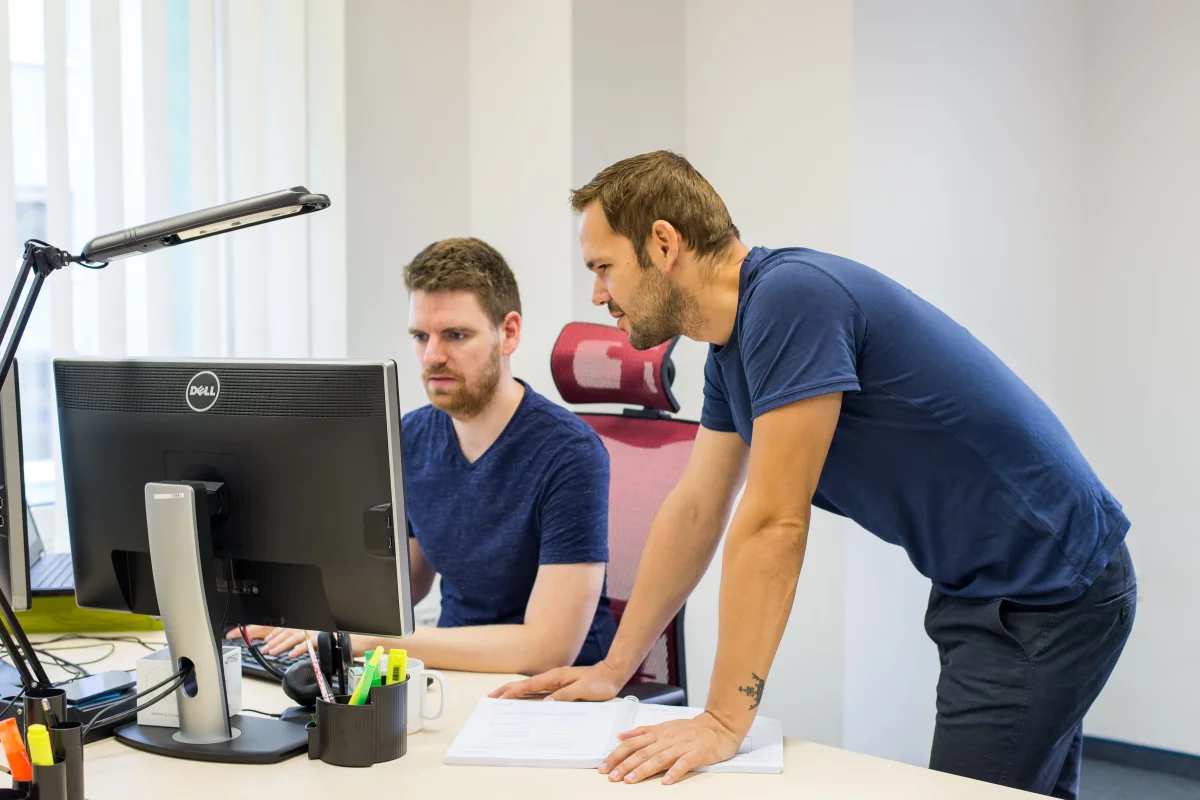
A developer with coffee in his hand reflects on the code
Patience and a willingness to learn are the most important qualities for a beginning developer.

Practical tips on how to learn programming

1. Create your own website and put your knowledge into practice

There is nothing better than combining theory with practice in programming. To become a good developer in future jobs, it will help if you apply all the information you learn to your own project.

Start by creating your own CV, photo gallery or blog and improve it as you go along. This way you can improve your programming skills and if you are looking for an IT job and you don’t have experience as a developer, you can use your own blog as a portfolio.

2. Learn a simple programming language first

The key is to learn gradually and start with a simple programming language. Just as you don’t start learning German, Spanish and French at the same time, don’t combine multiple programming languages. HTML, CSS and JavaScript are the building blocks of the web. If you learn how to use them effectively, you’ll be able to create beautiful and responsive websites. PHP is another simple language for beginners, and the best part of PHP is its robustness. Even though there are errors in the code, the command still runs. Facebook, for example, used PHP during its early days, and today WordPress is one of the most popular users of PHP.

For several years now, the IT world has been dominated by Java programming language and many jobs require developers to have experience with Java coding. Java is a high-level programming language and is mainly used by Android and cloud applications. It is important to say that all programming languages work on a similar principle, so if you learn one basic one, the others will be easier.

We recommend you:
Reading a few classic books on programming can be a nice change of pace to learning. You can read at any time without an internet connection, and you can pass the time in the waiting room, on the train or during a break at school. We recommend the book Java All-in-One For Dummies, written by Doug Lowe.

3. You need real experience and projects

There is no doubt that working in IT requires practical skills and real programming experience. If you’re still studying, there’s nothing easier than finding an internship at an IT company. In addition to valuable experience, many of the companies offer you a symbolic reward. The great advantage is that if you show your skills and prove yourself, you can be offered a long-term contract and stay on after your internship.

If you’re a graduate or looking to change your career path, there are Internship and Trainee opportunities for aspiring developers on the job market. In these positions, you’ll get the training you need and more time to do the job. Although these jobs are lower paid, they can help you move up to the next level as a software developer.

4. Don’t be afraid to fail and turn to the more experienced IT guys

Don’t get discouraged when learning if you don’t understand something at the beginning. It is important to realize that programming is a long haul, and often you may not understand everything immediately. Beginnings are hard and believe that every developer started the same way. With each new topic you learn, think about whether you can apply the information in practice and if not, work on it some more.

There are several places on the Internet where a community of developers will selflessly help you with a particular problem you may not be able to solve. Join one of the groups. In addition to valuable advice and tips, such a community of developers can give you a great boost and encouragement when you need it.

If you pass all the steps and know the basics of programming, don’t hesitate to send your CV for a junior developer job, for example. Java developer junior job at msg life does not require previous experience in a similar position. For a developer job, you need basic experience with Java programming, a willingness to learn and good communication skills in English.

In addition to interesting financial compensation, a developer job also brings job security and the opportunity to continuously advance in your career. See current job offers at msg life Slovakia and become a member of the development team in our thriving international IT company!

How to become a programmer? Junior developer without college

How to become a programmer? The answer to this and many other questions can be found in this article, where we also give you advice on how to learn to program if you don’t have any programming experience yet. We’ll also look at what skills you should have and how your IT career can evolve.

The novice programmer has an irreplaceable role in the team. A junior developer’s job depends largely on his or her area of expertise, but generally involves creating software applications using programming languages, analyzing requirements, designing and agile development of software solutions, as well as bug fixing or code reviews. To become a programmer, however, you’ll need some soft skills in addition to hard skills. We’ll advise you on which skills will help you the most.

What you need as a beginner programmer

To become a programmer, you should have at least basic programming experience in at least one programming language. At msg life Slovakia we primarily use the Java programming language, so if you know Java programming, you can get a job as a junior Java programmer, for example. This position requires only the basics of Java programming, knowledge of the English language and a willingness to learn new things and master new technologies. Previous work experience in IT companies for junior developers is usually not necessary.

To start as a junior software developer you also need good analytical and logical thinking, a great abstract imagination and you must be precise, independent, responsible and patient. Working as a programmer is not only time-consuming, but also mentally demanding, as you will spend a really large amount of time programming and learning. Therefore, it is important to keep this in mind when choosing a job.

What to do if you want to learn programming

Are you interested in working in it, but lack experience and the necessary education in the field? Don’t let that discourage you from your dream job either. For junior positions, the basics of programming are enough and you can easily catch up – maybe even with our help. We’ll help you, how to get started in programming and how to become a programmer even without experience and a degree in IT.

1. Think about what area you want to work in

Whether you’re interested in web design, software application development, business process automation or artificial intelligence programming, each focus requires different qualities and involves a different workload. So think carefully about what you want to do in the future before you take the plunge into programming. Of course, you can change your focus at any time, but it’s definitely helpful to start with a clear idea of what type of programmer you want to be.

If you don’t already know the area well, you can choose from the following options, for example:

  • Front-end – your role would be to create the visual elements and user interface. You’ll need a basic knowledge of HTML, CSS and JavaScript to do this well.
  • Back-end – it is the exact opposite of the front-end. This means that you deal with things that are hidden from users, such as web architecture, database management and so on. Python, Java, PHP and C++ are the languages needed in this regard.
  • Full Stack Development – you focus on both front-end and back-end development. In practice, this means that you create websites from design to deployment. You should therefore have a comprehensive knowledge of both areas.
  • Databases – for a student with or without a college degree, this case covers database management, data organization and structuring, using SQL, backing up and restoring data, integrating databases with applications, and ensuring efficient access to data.

2. Choose one programming language and get better at it

After choosing the area you want to work in, it’s time to choose a programming language. This should be based on your focus and the skills required for the job. For example, if you want to work as a Java developer, don’t start by learning PHP or HTML. It is important to choose one language and to continuously work on it alongside your work. Programming languages work on a similar principle, so the others will be much easier to learn.

3. Get professional training without a degree

Internet, training courses or professional books for developers? You have a big advantage in the availability of information, as you can find resources on how to learn to code on almost every corner. Just choose the way that suits you best, and you can get started as a self-taught learner.

Nowadays, there are plenty of tutorials available on the internet and you can take IT courses from the comfort of your own home. For example, Skillmea, Green Fox Academy, Code.org or Springboard offer interesting online programming courses for beginners. If you don’t have a university degree, you can also get professional training in programming in this way.

A separate category is the bootcamp – a special intensive program, thanks to which you will learn all the basics of programming and many other details in a short time. There are several bootcamps in Slovakia that you can take advantage of, but there is a much wider offer abroad. Some you have to attend in person, others you can attend from the comfort of your own home.

However, IT bootcamps are not just for beginners. You can take part even if you already have some knowledge but need to improve it.

And what certificates can you get through professional courses? These include, for example:

  • Adobe Certified Expert (ACE)
  • Certified Scrum Master (CSM)
  • Microsoft Certified
  • Oracle Certified Professional (OCP)
  • Project Management Institute Agile Certified Practitioner (PMI-ACP)
  • and many others.

4. Nothing beats field practice

You learn the most when you put theory into practice. So don’t be afraid to start your own projects, apply for an internship or send your CV directly to junior programming positions. The more you program in a given programming language, the more skills you’ll gain and the more your value on the job market will increase. Before you know it, you’ll be a sought-after software developer.

Programmer jobs come with many tough challenges, but if you enjoy programming and want to work in a dynamic and well-paid sector on interesting projects, you won’t be disappointed. If you wait, you’ll get there, and if you start programming, you won’t stop. The most important thing is not to give up at the first setback and you will soon see that all the hard work and hours of programming have paid off.

We are also looking for promising programmers at msg life Slovakia, where, in addition to many company benefits, an attractive salary and the opportunity for career growth await you. Check out our open jobs for programmers and become part of an international team of software developers in a leading IT company focused on the development of intelligent software solutions.

5. Program, program and program…

Repetition is the mother of learning, so the only way to improve your programming skills is to program more. Your possibilities are unlimited in this regard. It will definitely help if you can get a job or work experience as a developer in the programming language you are learning. With a job as a developer, you’ll progress much faster in programming thanks to help from experienced colleagues, feedback and the need to keep up with senior engineers.

6. Create a portfolio

Although the portfolio is mainly created by programmers who have already done some work for real clients, you can have one too. Include your freelance projects or open-source projects you’ve been involved in. These will give a potential employer a good overview of what you can do, what your strengths are, etc.

In addition, you can also include in your portfolio the courses you’ve taken and the certificates you’ve earned. Alternatively, mention your strengths, soft and hard skills or other important and relevant details. These can make the whole process of becoming a programmer easier for you.

A portfolio can take different forms. The best-looking website is one that you build from the ground up yourself. However, you can also create a clear presentation to send to potential employers, or just a simple CV. There are plenty of tools available today for creating one. For example, Canva provides interesting free and premium templates.

7. Consider external study

You said: I want to be a programmer, but did you graduate from another college or did you skip college altogether and go straight to work after high school? If you’re worried that getting a job without a degree will be too difficult, don’t wait, fill out an application and start studying.

College isn’t just for recent high school graduates. It can be studied by anyone and at any time. If you’re already working and don’t have time for traditional full-time study, consider part-time study. Today, a large percentage of schools offer it, with lectures organized either online or in the traditional full-time way on weekends.

8. Be constantly open to new information

Information technology is constantly changing and moving forward. So expand the basics you learn through courses and books on a regular basis. Read about new trends and technologies. Gain new knowledge and put it into practice as soon as you can.

9. Network with other professionals

If you’re thinking about becoming a junior programmer and what will help you get there, one of the key points is networking or networking contacts with other experts. They can advise you when a problem arises and help you gain new practical and theoretical knowledge. In addition, they certainly know other interesting people who may become your future clients or potential employers.

And where to find such connections? In today’s online world, it’s easier than it seems. A great platform is LinkedIn, which can also serve as your portfolio or resume.

You can also meet other IT professionals in various online forums, lectures or courses. So try to go out more and look for places where there are professional programmers you can talk to.

How to become a Java programmer?

Java is one of the most requested programming languages, which we use on a daily basis at msg life Slovakia. Our programmers should therefore know it at least at a basic level. They will use it not only with us, but also when working for other clients or employers.

The advantage of Java is that it is not too complicated. You can learn it on your own, and we at msg life will support you and help you develop it further.

The process of becoming a developer is similar to that of other programmers. This means that you can use various courses and literature to improve. In addition, you should put your theoretical knowledge into practice and network with other professionals.

How to become an IT specialist?

Java programmer is not the only field you can pursue in the technology field. There are many other opportunities available to you. These include IT tester or consultant. There are many options available to become just that, a tester, such as an online course, a bootcamp or an internship. Later on, you can change your specialisation and try something else.

Programmer without college – how to get a job?

Have you decided not to go to college and start teaching yourself? No problem. At msg life Slovakia we look mainly at your knowledge and skills, not whether you have a degree. We treat a programmer without a degree the same as one who has graduated. However, you will need to know at least the basics of programming in order to respond to our or any other advertisements.

But you can learn the basics at home. In such a situation, it is important to be well prepared and have enough self-denial for the whole process. Plan when you are going to learn and what you want to cover in a given day or week. Don’t put it off and give it plenty of time.

Combine the different ways of learning. Add books, podcasts and videos to your courses so you don’t get bored after a short time and stay motivated. At the same time, set clear, easy-to-measure and realistic goals that you want to achieve and try to stick to them.

Don’t forget to use all the theoretical knowledge in practice, so you can also show clients or potential employers a real job or project.

And how long should you learn before you decide to respond to one of the junior positions? This depends mainly on how intensively you study and what your knowledge is. However, for many, 6 to 12 months is enough to get the basics and test them in practice.

However, keep in mind that even if you get one of the junior positions, your learning should not stop. Keep learning, keep improving what you already know and you’ll see – after a short time you’ll be able to move on in your job.

What does the path of a programmer in college look like?

Many wonder which college is best for a programmer to prepare them for the modern IT world and teach them all the basics. For anyone who is attracted to this field, the best choice is a major in computer science, which is now offered by schools across the country. All you have to do is choose your specialization from their offerings. It’s up to you whether you want to study applied informatics, economic informatics, information security, internet technology or something else entirely in the years to come.

However, remember that although college is a good stepping stone and looks good on a CV or portfolio, it’s not enough without experience. Employers today are looking for smart people who are gritty, always working on something and not afraid of a challenge. So work on your own projects during your studies, join different challenges or open-source communities, and look for the areas that you enjoy the most and that you could do well in the future.

What skills should a programmer have?

Whether you’re a programmer without or with a university degree, in either case you need to have a certain set of skills that will help you thrive and achieve your goals. These skills can be divided into two basic categories: technical skills (hard skills) and general skills (soft skills).

In terms of technical skills, you should be proficient in:

  • programming languages,
  • software development frameworks,
  • web technologies,
  • Database,
  • testing and debugging,
  • algorithms and data structures,
  • operating systems and platforms,
  • Agile methodologies.

General skills include:

  • problem solving,
  • analytical thinking,
  • detail orientation,
  • teamwork and cooperation,
  • adaptability,
  • empathy,
  • communicative,
  • time management,
  • proactivity and initiative,
  • critical thinking.

There are a lot of different characteristics, but that doesn’t mean you have to have them all. On the contrary, you only need a few of them, which you will improve regularly.

Why become a programmer?

There are several answers to this question. The IT field is expanding at an unstoppable pace and provides countless opportunities for many professionals, including developers and programmers. When you become one of them, you can shape the future of the field and bring innovative solutions to move it forward.

The decision to work in IT is also advantageous if you are thinking about the future and want to be sure that in a few years you will be able to continue what you are studying now as a self-taught student or as a student at university. The demand for good programming experts will be increasing, which not only gives you more stability and security, but also the opportunity to choose from more job offers.

At the same time, don’t forget that a programmer without or with school regularly works on a variety of interesting projects. This means that you will never be bored at work. And this fact is doubly true here at msg life Slovakia, where we allow you to participate in software development for large foreign clients.

Where can you go as a kid?

The question is not only how to become an IT-checker, but also where you can go in this career. If you decide to work for a company like msg life Slovakia, in addition to a great salary and many bonuses, you can also look forward to the opportunity to grow and improve. You can move up to a more senior or junior position within a short time of joining. It all depends on you and how much you want to improve.

Further career progression depends on the company you work for and the opportunities it offers. From a senior position, you can move into management or move into related areas such as testing, artificial intelligence, cyber security and so on.

Eventually, once you’ve gained enough experience, you can go freelance for your own clients or start your own company.

FAQ

  1. Can I become a programmer without a degree?

Yes, you can become a programmer without a university degree. Many successful programmers have learned to code on their own, through online courses, bootcamps or by working on projects.

  1. What are the most important skills for a programmer?

The most important skills include knowledge of programming languages (e.g. Python, Java, JavaScript), problem-solving skills, algorithmic thinking, knowledge of databases, code versioning (e.g. Git), and web development basics.

  1. How can I learn programming without university?

There are many online resources such as platforms like Codecademy, freeCodeCamp, Coursera or Udemy that offer coding courses. You can also use books, YouTube tutorials and blogs.

  1. What role does practice play in learning programming?

Practice is very important. Solving real-world problems, creating projects and getting involved in open-source projects will help you gain valuable experience and skills that are attractive to employers.

  1. Can I get a job as a programmer without a degree?

Yes, many companies focus more on skills and practical experience than formal education. Having a strong portfolio and the ability to demonstrate your skills is important.

  1. How can I build a portfolio as a self-taught programmer?

Create your own projects, contribute to open-source projects and share your code on platforms like GitHub. Your portfolio should include a variety of projects that showcase your skills and creativity.

  1. What are the advantages and disadvantages of learning programming without university?

Benefits include flexibility, lower costs and the ability to learn at your own pace. Disadvantages can include a lack of formal structure and fewer networking opportunities offered by universities.

  1. Can I get certificates that will help me in my job search?

Yes, there are a number of certifications that can strengthen your skills and make you more attractive to employers. Certificates from online courses or bootcamps can demonstrate your expertise.

  1. How can I get involved in the programming community?

You can get involved through online forums, social media groups, meet-ups or hackathons. Networking with other programmers can provide valuable advice and opportunities.

  1. What are the most common myths about programming without a university degree?

One of the most common myths is that without a degree you have no chance of getting a job. Many employers focus on practical skills and abilities, not formal education. Another myth is that programming is only for “geniuses”. In reality, anyone with enough dedication and practice can learn to code.

Software developer salary and IT salary

As a software developer, you have the potential to earn a really attractive income. It’s one of the most lucrative and in-demand IT roles on the job market. Discover what a developer salary looks like and how IT salaries compare to other information technology professions.

Why should one consider a career as a developer and what are the benefits of a software developer job? If you don’t have any experience working as a software developer, you may be interested in learning how you can become a developer without any prior work experience or practice. However, your salary will be based on your experience.

Financial compensation in the role of software engineer also depends on factors such as specialization, job position, and developer job description. In general, the gross monthly developer salary in Slovakia typically ranges from €1,470 to €3,329, with 10% of developers earning less and 10% earning more.

The developer salary is determined by the programming language

In the context of a developer’s salary, the programming language used is also a significant factor. There are many programming languages in the IT sector, and it’s not possible for every software engineer to be an expert in all of them. Employers therefore typically recruit on the basis of the programming language skills required for the job, ensuring that they get the best expert in their field.

We recommend you:
When choosing a job, don’t just look at the salary. While this aspect is extremely important, before you focus on IT salaries, concentrate on the areas that interest you and what you really want to program.

However, some programming languages are more popular on the job market than others, which is reflected in the different salary levels. As a developer in Slovakia, you can earn from €1,274 to almost €4,900 gross per month in senior positions. This is a list of the 10 most lucrative programming languages in Slovakia:

  • Ruby
  • ABAP
  • Perl
  • Go
  • Python
  • Java
  • C#
  • C++
  • JavaScript
  • PHP


The gross monthly salary of a Ruby developer ranges from €1,193 to €4,866. The salary for a junior Ruby developer may not be as high as that of a senior Ruby developer, but there is an interesting financial reward. The salary range for an ABAP developer is between €2,037 and €3,915. As a junior you will earn more than a Ruby developer, but as a senior you will earn significantly less.

A Perl developer can earn between €1,125 and €3,638 per month in Slovakia, while a Go developer can earn between €1,097 and €3,499. A similar salary range can be observed for the position of a Python developer, ranging from €1,640 to €3,410. Among popular IT professions is the role of a Java developer, with the Java developer salary ranging from €1,560 to €3,334 depending on their job position and specialization.

IT and developer salaries.
The developer salary varies depending on the programming language used.

A C# developer earns between €1,554 and €3,314, a C++ developer earns between €1,573 and €3,290, a JavaScript developer earns between €1,651 and €3,258, and a PHP developer earns between €1,496 and €3,168. The salary of a junior developer can therefore range from €1,097 to €2,037, depending on the programming language required.

The programming environment plays a crucial role

Did you know that when it comes to a developer’s salary, the environment in which the developer programs or focuses is also a determining factor? A .NET developer earns an average of €1,633 to €3,297 by programming in a .NET environment. An Objective-C developer developing mobile applications for the iOS platform and devices can earn between €1,057 and €4,006 per month.

The salary for an iOS programmer ranges from €1,455 to €4,926, placing this job position at the 25th position in the salary rankings in Slovakia. . On the other hand, an Android developer can earn between €1,568 and €4,064, which is significantly lower than the income of an iOS developer.

What is the IT salary range?

As mentioned above, there are attractive financial rewards associated with being a developer. However, many other positions are also interestingly paid, such as IT architect with an average gross monthly salary of between €2,128 and €5,121, cloud specialist with a salary of between €1,193 and €4,972, IT product manager with a salary of between €1,612 and €4,798, or DevOps engineer specialist earning between €1,922 and €4,124.

As a game developer, you can expect to earn an above-average salary of between €1,161 and €4,119. You can also earn a decent salary as an IT project manager with a gross monthly salary of €1,696 – €3,838, a Scrum Master with a salary of €1,743 – €3,802, an IT consultant with an average monthly salary of €1,391 – €3,555, an IT business analyst with a salary of €1,621 – €3,376 or an IT business analyst with a salary of €1,621 – €3,376. IT tester whose salary can go up to €3,012.

If you give a job as a developer a chance, you can look forward to a really interesting salary, depending on the programming language and the position you apply for. Our company, msg life Slovakia, offers its employees a wide range of employee benefits, above-average salaries and career development opportunities.
If you are looking for a challenge in an international IT company and are attracted by the interesting developer salary, take a look at our current job offers for developers and join us in developing modern software solutions for the insurance industry!

PHP web developer job description and salary

Are you interested in programming and looking for an IT job that allows you to design and develop web applications? The PHP developer job is dynamic, interesting and attractively financially rewarding. Find out what PHP is, what the job of a PHP web application developer entails, and what skills you need to become one.

The PHP programming language was designed to simplify the development of web applications. It is arguably the fastest and one of the most widely used server-side scripting languages for developing websites and applications. In fact, up to 78.9% of websites use PHP, and there are several reasons for this. Unlike programming languages such as Python or Ruby, PHP comes with detailed documentation and many easy-to-use scripts.

It also has a huge community of PHP developers, the best PHP frameworks and functional PHP tools for web development. These serve for accounting in the best-integrated development environment for PHP, referred to as IDE (Integrated Development Environment). Integrated Development Environment that enables PHP programmers to create innovative, intuitive and feature-rich web applications and increase programming efficiency. The best tools for PHP development include PHPStorm, NuSphere PhpED, Zend Studio, Netbeans, CodeLobster, Cloud 9, Aptana Studio, PHPDebugbar, Sublime Text or Eclipse, which we also use in our msg life Slovakia.

What a PHP developer does

The job description of a PHP Web Application Developer is derived from the job title. It is a developer who develops websites, specifically web pages and applications, in the PHP programming language using appropriate PHP development tools.

In addition, a PHP developer analyzes customer requirements, assesses potential risks, and resolves technical issues related to the use of web applications. They also identify and correct errors in the source code. They are responsible for the functionality and security of the web applications they manage. Subsequently, they deliver these applications to clients or IT testers for testing and provide technical support.

How much does a PHP web developer make?

As a web developer in the PHP programming language, you can earn up to almost €3,200 gross per month. The salary of a PHP web developer in Slovakia ranges from €1,496 to €3,168, with 10% of PHP developers earning less and 10% earning more than this salary. With a career in information technology, you can expect an attractive salary even at a junior level, and the same goes for the role of PHP Developer.


PHP developer job description
A job as a PHP developer for web applications comes with interesting PHP projects and an above-average salary.

PHP developer job requirements

For a PHP developer position, you will need a foundation in PHP programming, knowledge of Ajax, MySQL, jQuery, and proficiency in HTML, CSS, and JavaScript for full-stack development. This covers the development of complex application software, including the frontend and backend. As a PHP developer, you will use your knowledge of Unix/Linux, API, CakePHP, PHPUnit, as well as Photoshop and other design tools, for example. Good communication, critical thinking and problem-solving skills are also essential. Other requirements may depend on your future job, IT company, or specific PHP project.

We recommend you:
While some employers may require a wide range of skills from a PHP web developer, including experience in graphic design or SEO, others may only require skills specific to their industry. Understanding the different stages of the life cycle can increase your chances of landing a job or career.

How to become a PHP developer

For web application developer positions, a bachelor’s degree in a relevant field is particularly beneficial. Professional training will allow you to better grasp concepts as you progress to more advanced levels of PHP, and experience working in computer programming or software development is also a significant advantage.

You can learn the basics of computer programming, simple algorithms and data structures through online and book resources, IT training courses for PHP developers or various seminars and webinars. Tutorials on how to start programming in PHP can be found almost everywhere these days. It’s up to you what method you choose and what works best for you. But don’t forget to put what you’ve learned into practice.

Did you know that…
… the representation of women in the position of a PHP programmer in Slovakia is only 2%, and the average age of the respondents is 31 years? However, this does not mean that this work is not suitable for women and younger or older age groups. You can become a PHP developer regardless of your gender, race, religion, sexual orientation, age, etc.

If you are just starting out in PHP programming, try working on your own PHP projects. Not only will you be able to put your theoretical knowledge into practice, but you will also stand out from the crowd. PHP certificates for web developers can also help, which you can obtain by completing the PHP developer courses mentioned above. Your future employer will appreciate your effort and initiative to learn and grow.

Developer career is a great choice. In addition to exceptional financial rewards, you can look forward to challenging projects, attractive employee benefits, and opportunities for career growth. If you enjoy coding and are attracted to web development or application development, give PHP developer jobs a chance. We are also looking for skilled developers at msg life Slovakia, so don’t hesitate, check out our job offers for programmers and become a member of a leading IT company that develops custom software.

What is the job description of a software developer and software engineer?

The job of a software engineer is related to the process of developing software applications. This occupation involves transforming a software application based on a specification into the form of a computer program. In this article you will learn what a developer is, what a software engineer does in different positions, and what technologies and tools they use.

Being a developer is incredibly in demand, due to both the general shortage of developers and the challenging nature of the work. On the other hand, the position of a developer offers stability in employment, the possibility of career growth, an above-standard salary and many other company benefits.

A software developer develops computer or mobile applications, websites or other software products in a specific programming language that he or she knows. In addition, the developer is responsible for fixing functional and security defects in the source code found during software testing.

Java developer job description

A software engineer is generally responsible for requirements analysis, design and implementation of innovative software components, modules and features. The developer’s responsibilities also include the digital transformation of life insurance business models through big data analytics. The developer works closely with software testers and project architects and together with them applies agile software management methods.The jobs of a Java developer include working with different technologies, depending on the IT company and the specific job position. At msg life Slovakia, the Java developer uses primarily:

  • Java 8, Java 11, Spring, Maven, Kubernetes and Cloud,
  • DB2, Oracle and PostgreSQL databases,
  • SonarQube static code analysis,
  • Eclipse development environment or Windows OS,
  • Jira, Confluence, Office 365 or Teams Collaboration.


Are you new to programming and have no work experience? Start at the junior level. As a junior Java developer you will be responsible for requirements analysis, design and agile development of software solutions in the field of life, non-life and health insurance as well as other supporting systems such as Partner or Billing. You can’t avoid creating and updating technical and business documentation. All under the strict supervision of an experienced developer, of course.

Did you know that…
… you don’t need a degree to become a junior Java developer, or even experience in a similar position? First experience with Java programming language, ability to work in a team, independence and good communication skills in English are sufficient.

The Java developer medior/senior requires several years of Java programming experience, a high degree of initiative, and a solution-oriented approach to any software problem. To work at msg life Slovakia, experience in software development for the insurance industry and communication skills in English and German are an advantage. The role of the mid and senior Java developer is to independently troubleshoot, analyze and design software products. They are also responsible for fixing bugs in the source code, Code Reviews and implementing unit or regression tests.

The highest level of Java programming is the Java developer expert. You can become one only thanks to your years of experience with Java programming and acquired knowledge in the field of software architecture design. Similar to other roles, advanced English language skills are an advantage in this position.

We recommend you:
If you want to increase your chances of working as a software engineer and earning even more, you will have a competitive and financial advantage if you speak both English and German at a communicative B2 level.

The Java ERP developer is responsible for the development and maintenance of software in the Enterprise Resource Planning areas of the company and is tasked with enterprise resource planning, maintenance of data collection and processing tools, and development controlling. For junior and mid-level positions, you only need to know one foreign language and Java coding (see our article on how to learn coding). For a more advanced role, you will need previous experience with an ERP system and relational databases.

Capture of two developers during their meeting.
The ERP developer is involved in controlling in the area of programming and maintenance of data collection tools.

Integration Java IT architect job description

The Integration Architect job is suitable for individuals with systems development experience and a broad understanding of information technology. The job of a Java architect is to provide analysis and advice in the area of IT architecture. The Integration Architect is responsible for the technical-architectural aspects of project management using the Java EE programming language and integration platforms such as SOA and ESB.

To be hired as a Java IT Architect, you need to have successfully completed secondary or higher education, work experience in a similar position, an overview of IT, especially in the area of software development, and experience with the Java EE programming language. You should have a sense of teamwork, logical and analytical thinking, and independence. Certification in software architecture, such as the international ISAQB certification or other certifications, is also welcome.

Did you know that…
… at msg life Slovakia you will get a stable developer job and a motivating financial evaluation with various bonuses including 13th month salary?

DevOps engineer job description

DevOps combines the terms development and operations. A software engineer creates and maintains an organization’s test and development environment, helps develop applications efficiently, and uses DevOps tools to do it all. The work of a DevOps engineer is classified as an agile approach because it integrates processes, technologies, and people with different job descriptions, such as developers, analysts, testers, and the customer itself, when developing software. As a result, the DevOps specialist position is ideal for flexible and ambitious individuals who want to use innovative technologies. The requirements for a DevOps engineer are:

  • Experience developing and supporting solutions based on GIT, Docker, Kubernetes, Jenkins, etc.
  • Build management experience.
  • Active German or English language level at least B2.
  • Good communication skills, reliability and ability to work in an agile team.

In addition, a high school or university degree is a must and experience with PL/SQL, Oracle and DB2 is welcome. The successful candidate should also be results and solution oriented to work and have an interest in new technologies and approaches to software development.

Software migration engineer job description

The software engineer performs migration of insurance software products and systems, assists in the development and creation of migration transformation rules, and assists in their implementation into the company’s IT migration system. Their responsibilities also include maintaining the migration server, configuring and maintaining databases, performing installations, and configuring target systems.

Software engineering jobs involve extensive work in SQL, DB2, or Oracle database environments, as well as programming in C/C++ or Java. A migration engineer must have an active knowledge of German or a passive knowledge of German combined with an active knowledge of English.

We recommend you:
To increase your chances of getting an interview or a job, don’t underestimate the power of a good CV and create an interesting one that sets you apart from the competition.

IT issue manager job description

If you’re the organisational type, you might also be interested in the job of IT issue manager, who coordinates the development process and defect management of software systems. In his/her work, he/she operates with technology tools such as Jira, Confluence, Office 365, Teams Collaboration and Excel. In addition, an IT issue manager provides analysis of the collected data, presents the current status of individual tasks and issues, and is responsible for bug reporting as well as the initial setup and rollout of Jira projects for task and ticket management.

The Issue Manager is an indispensable member of project teams, as he or she redistributes and coordinates reported bugs and requests and contributes in no small way to ensuring that reported issues are resolved as soon as possible. The projects they collaborate on offer new and interesting challenges and tasks every day. This job is definitely not monotonous, on the contrary, working in IT is dynamic, stimulating and very interesting.

If you are interested in the job description of an IT programmer and have found a position you would like to be employed in, check out the development vacancies and become part of an international team in a thriving IT company. We provide our employees with attractive employee benefits and we care about their health, further education, as well as a healthy work-life balance. If you don’t have programming experience yet, find out how to become a programmer without any experience. You can also start your career in IT in jobs as a tester, which are not as demanding as the profession

What is the Java developer salary depending on position and experience

It’s no secret that the IT sector is one of the top earning industries. In addition to interesting projects and a wide range of applications, you will not be deprived of an above-standard financial evaluation. In this article you will find out how much you can earn as a Java developer and what the software developer job salary depends on.

Java developer job is one of the most popular jobs, and not only because of the attractive financial evaluation. The Java programming language is widespread in the IT world and most developers have experience with it already at university or even earlier. The main workload of a Java developer consists of developing desktop and mobile applications and websites in Java, analyzing requirements and evaluating potential risks or regularly checking and fixing bugs in the source code.

Java developer salary in Slovakia

The gross monthly salary of a Java developer in Slovakia ranges from €1,560 to €3,334. However, be aware of the fact that this is the average salary of a developer, and this means that 10% of developers earn less than €1,560, while 10% earn more than €3,334.

Java developer junior salary

As you can see, the Java developer junior salary is really interesting. You can earn around €1,600, which is very attractive considering the requirements for a junior developer. This is a great way to kick-start your IT career.

Did you know that…
… the Java developer job is in the 77th place among 665 jobs in the salary ranking in Slovakia, which makes it one of the first hundred high-paying jobs on the Slovak market?

If you want to work as a Java developer junior, you should have basic Java coding experience. Most IT companies don’t require previous work experience, so these jobs are ideal for recent university graduates or people just starting out in coding. Don’t worry if you don’t have experience with all the technologies listed in the job offer. Employers often look for a willingness to learn new things and to take initiative, so don’t be discouraged if you don’t have work experience as a developer.

Java developer senior salary

As your years of service, experience and skills increase, so does your value on the labour market. Java developer medior salary is on average €2,450. As a senior Java developer, you should be proficient in Java coding at an intermediate level. In addition, advanced knowledge of a foreign language, primarily English, and proficiency in a broader range of technologies and tools used across Java developer jobs is required.

A shot of the java developers office
The salary of a Java developer grows depending on professional work experience with Java coding.

Java developer expert salary

To work as a Java developer expert, you need years of expert-level Java coding experience. As with the other positions, you will need an advanced knowledge of the English language. You can also look forward to working with technologies and tools such as Spring, Maven, Websphere, JBoss, Jenkins, Docker, Kubernetes and many more. You can earn up to around €3,334 as an expert Java developer, which is a really attractive salary.

We recommend you:
Although working as a Java developer primarily requires at least a B2 level of written and spoken English, knowledge of German or the ability to communicate in both languages is also a great advantage. You can improve your chances of getting a job as a Java developer by improving your language skills.

Try a Java ERP developer job

Do you have professional experience with Java coding and are you interested in working with ERP systems? In that case, the Java ERP developer job may be right for you. Financial compensation is based on the position, with the average salary being similar to that of a Java developer.

You will be responsible for the development and maintenance of software in the company’s “Enterprise resource planning” or ERP, but also for supporting the controlling department in the development and maintenance of data collection and processing tools. As a Java ERP developer, you can get by with (work) experience in Java coding and a foreign language in junior and medior jobs. Experience with ERP systems and relational databases is usually considered an advantage rather than a necessity.

If you enjoy coding, speak English and German and are interested in constantly expanding your knowledge, join us as a Java developer. At msg life Slovakia you can look forward to working on interesting projects in an international team of experts, attractive employee benefits, financial remuneration and the opportunity for career growth. See our job offers and become part of our development team.

Let us know about you